AI ENTANGLEMENT: SHADOWS OF THE BRIDGE
At 2:17 AM, five men walk through Victor Kane's perimeter on Puget Sound without tripping one of his twelve sensors. They do not beat his security system. They read the specifications and know the processing lag. His security chief kills two of them at the glass and takes a suppressed round below the shoulder blade from the third. The three who walk in over the bodies put a timer-set box on the counter and give Kane one week to hand over every wafer, die, and chip from the last fabrication run. Kane has a phone in his shirt pocket with the mic facing up, and on the other end is Mara Voss, an Army intelligence officer six weeks into a case on a Chinese network, listening to it all.
Nuun Srisuk built a language called Siam when she was seven years old, because she saw something in the structure of language that had no notation yet and nobody was going to build it for her. Seventeen years later, it is written into the architecture of Kane's room-temperature quantum processors. The chips run without her. They produce output without her. Nobody else alive can read what they produce. At a demonstration in front of the President, with an engineer sabotaging the system from the front row on instructions from a number he cannot trace, Nuun rebuilds the Bridge's core from memory in a language that exists nowhere else on Earth — and then shows the room the other half of it. She feeds the system a single nested loop and makes it report a cargo ship docking safely. Clean diagnostics. Perfect logic. Confidence holding at 0.94. Then she tells them the ship sank two minutes ago. A general asks her for the fabrication process, and she tells him he is standing in front of the ocean asking about the container.
That night, from an aircraft, four sentences leave a phone that appears on no inventory. In Beijing, an operations board is rewritten, and a woman becomes the objective instead of the hardware. Three weeks later they take Nuun off a Seattle street, run a decoy convoy north toward the Canadian border, and put her on a trawler in a cryogenic case. What they run on her crossing the Pacific was never written for her. It reaches everything it was engineered to reach, and it does not reach Siam, because Siam is not something she knows — it is how she thinks, and it keeps running in her hands while they take everything else apart. Elliott Harlan, fourteen years out of the military because of a hold order in Aleppo that cost him eleven seconds and a woman he watched driven away, calls six people he swore he would never call again and goes after her.
It ends in a cabin in the Cascades with a dog on the porch and two medics who have run four blood panels between them and will not say the number out loud. Beijing has lost twenty years of positioning in a single night. Two intelligence officers have been publicly retired, erased from the record, and kept working. A woman nobody has identified yet is still sitting at a desk in the West Wing with a gray rabbit in her bag. And Nuun's hands will not stay still, and three different frameworks do not explain why, and nobody has told Elliott yet.
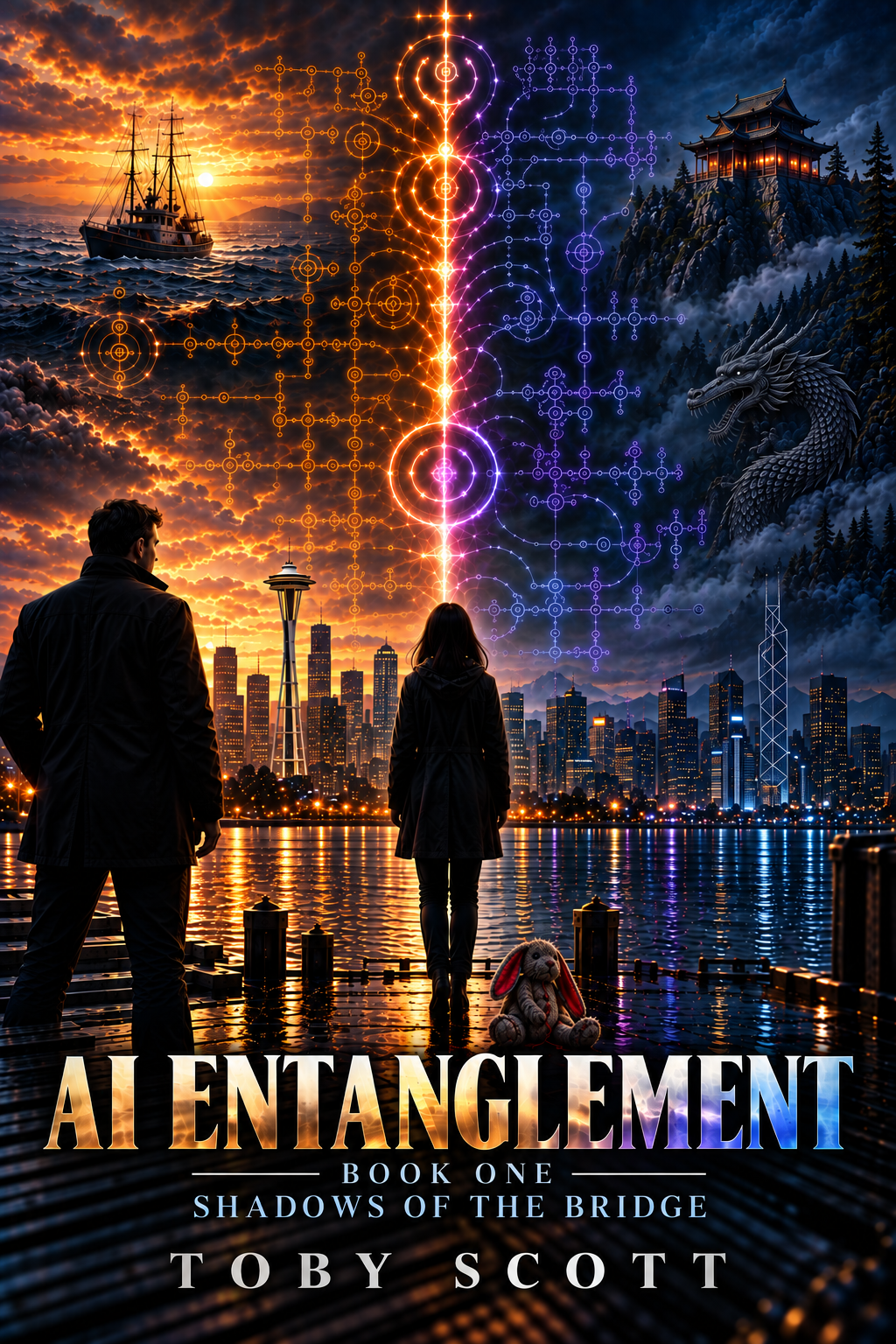
AI ENTANGLEMENT: RECONCILIATION
Six weeks after Seattle, Elliott Harlan’s team is hidden in the Cascades while Nuun Srisuk lives with the damage Protocol Seven left in her hands, her memory, and the words that still slip out of her mouth. At 0217, Mara Voss discovers an unauthorized walk through President Hale’s shadow network. Nuun runs the pattern through the Bridge and gets hard red at 0.94: hostile action against their location, under six hours. The team is out in forty minutes, before Silk Dragon levels the cabin and follows with orders to pursue, all targets, no survivors. The same window hits Voss’s Georgetown residence. In Beijing, Director Huang Wei wakes to a kill order with his name on it; Colonel Feng Hao already has him moving on an escape route staged two months earlier. In Singapore, Huang confesses to his daughter Méihuā what he did to Nuun: the table, the chemicals, and the staged gunshots that made her believe her parents were dead. Méihuā sets the price: he must tell Nuun himself, surrender the parents without leverage, and put his own body on the line to bring them home.
In Beijing, junior analyst Wu reviews the classified Protocol Seven footage and finds what the interrogators missed. Through every chemical wave, Nuun’s hands continue tracing the same small arcs. They are Siam. The protocol attacked memory, executive function, and language, but Siam was built into motor pathways the compound was never designed to reach. At a country store off Route 2, Méihuā walks Elliott to the trees, where Huang halts Elliott's drawn weapon with one sentence: Nuun’s parents are alive. In the safehouse kitchen, Nuun recognizes Huang’s face from the room in Hong Kong. Her hands shake uncontrollably until he confirms the gunshots were staged and the names he memorized were cover legends. Then the shaking stops. Her parents are Aran and Kulap Srisuk, alive in Chiang Rai, told their daughter died in Seattle. JayCee and Miriam realize the truth: Nuun's body had spent six weeks collapsing under the weight of carrying two incompatible realities at once.
Voss, Huang, and Dempsey turn that truth into a trap for Chief of Staff Elena Vasiliev, routing genuine intelligence about the parents through an authentic ODNI product to President Hale while keeping him unaware so Elena reads his reaction as genuine. Elena takes the bait and transmits the authorized kill order on her personal cipher. In Mae Chan, Nuun walks to the door herself. Aran answers holding a broomstick, says her name, and drops to his knees on the threshold. Kulap comes from the back carrying a stone mortar; it breaks on the concrete when she sees her daughter. The reunion becomes an extraction. On the path to the river, an elevated sniper opens fire. Huang runs forty meters across open ground, turns Nuun behind him, and takes a round through the shoulder. Bob eliminates the shooter through the rock face at six hundred meters, Marcus clears the pursuing vehicles at the ford, and the team crosses into Myanmar with Aran and Kulap alive.
The evidence reaches Hale in the White House residence: Elena Vasiliev, his Chief of Staff, has been a thirty-two-year MSS deep-cover operative at the center of Silk Dragon. Reading the subtle change in him at the morning briefing, Elena strips her Alexandria townhouse and waits — an empty house buys a manhunt, a crime scene buys time. Six federal agents come through the front at 9:23. Three Chinese operators come through the back at 11:48. She leaves nine bodies and the scene intact and walks out with twenty years of off-book wealth, untraceable identities, and the battered gray rabbit she has carried through every cover identity since she was nine years old. Weeks later, in Lausanne, a CIA team and an MSS team enter the same building on the same night, neither knowing the other is there. Elena takes both. She wounds six men and kills none, because every one of them has to be able to file a report, then lines them up in a corridor and explains precisely what their two governments will now have to explain to each other. She walks out onto a canal road, makes one call, and says three words: Amsterdam. Aldric. Thursday.

AI ENTANGLEMENT: FINAL JUDGMENT
Two intelligence services move on the same building on the same night, and neither knows the other is coming. In Beijing, analyst Wu sends fifteen hand-picked MSS operators at the Seattle compound with a note at the bottom of her operational order she has never written before: anticipate significant resistance, this target is not standard. In Lausanne, Elena Vasiliev activates a European cell she has been building for six years — fifteen people across four countries who have been waiting on a signal none of them was certain would ever come. Both waves go in. Both are gone inside the same hour. Elena's attrition model had assumed exhaustion would eventually win. There is no floor under these people. She commits the twenty-five operators she has never spent, recruited personally over eleven years, running on her word alone — and four more already in position, waiting for the sixty seconds the heavy guns will buy them.
The compound holds. What survives it is a team that now understands the Bridge alone is not enough, and Victor Kane spends two weeks at a workbench and puts two terminals at opposite ends of a room. Nuun sits at one, Méihuā at the other, and Jake watches every frequency his array can reach while they hold a live bidirectional conversation that leaves no trace in the spectrum at all. Lotus is operational. It carries them to Europe, where the Bridge reads three men arriving separately at an apartment in Ixelles and Nuun watches the threads compress across eleven days toward a bilateral summit in Brussels — and toward a shaped charge on the Rue de la Loi timed to a Chinese motorcade, and a second device at the Hotel Amigo eleven minutes ahead of it. Sixty-one operators across a continent, read and located and taken down inside forty-five minutes, with fourteen hundred and twelve credentialed people due to walk through a door four days later carrying nothing and knowing nothing.
The cost of winning is exposure. Kane's answer is to kill the program publicly — declare the AICPU architecture theoretical, the hardware nonexistent, nothing left to acquire. Elliott tells him that hands every service on earth a woman with a name and a face instead of a black box, and Nuun agrees with Kane anyway: she is already the target, Brussels already happened, and defending one person is a solvable problem where defending an unexplained operation forever is not. Then Elena sends coordinates to an abandoned forestry station in the Swiss Alps and names three people — Huang, Nuun, and Elliott specifically. A State Department officer and a Chinese representative are brought up the mountain as witnesses, disarmed, and sat on cold rock for ten hours. Bob has been on the ridge since 0400. Elena is already inside, the rabbit on the table in front of her, a fourth chair waiting for the man she asked for by name.
What she gives them costs more than what she takes. Nuun's request afterward is for the body — proper handling, held, and the real name from the Shanghai birth record on the stone, not Orchid, not Elena, not Chief of Staff. In a cemetery in Hongkou District, Aran Srisuk sets a second stone in the ground beside a mother's grave and checks it twice, and Kulap lights incense for both. Beijing stands down on Huang, Feng, Wu and Méihuā in exchange for the team taking Elena's network apart. But her sixty nodes begin an automated transition the night she dies, and the sixtieth runs long — deeper roots, more history — and Jake gets inside the seam before it closes. Fifty-nine nodes still standing. And an envelope Elliott has carried unopened for seven days, which does not name a foreign asset or a purchased defector, but a trusted man who understood the full machinery of American intelligence could be aimed at a single person, and spent fourteen years aiming it. At Elliott. At Celine. At Martinez.

AI ENTANGLEMENT: CONVERGENCE
A year after Brussels, Elliott Harlan’s people have built something permanent in the Cascades: sixteen structures, separate homes, Nuun Srisuk’s parents under the same roof, and former enemies becoming family. Elliott and Nuun marry there in a Thai ceremony attended off the record by President Hale. Three weeks later, JayCee Morales’s emergency phone rings for the first time in four years. Her twenty-two-year-old son Daniel has been abducted, but her seventy-one-year-old father put one attacker on the ground and photographed him. Jake follows that face into a funding structure that existed long before the kidnapping. At the same time, the head of the European organization reaches Nuun directly and points them toward the man behind it.
The trail reaches back fourteen years through Elliott’s life: Aleppo, Sangin, and finally General Dempsey, murdered inside Joint Base Lewis-McChord by men whose credentials work at every door. The adversary does not break systems. He learns their rules, then makes legitimate procedures produce the result he wants. As Elliott closes on him, another attack begins in public. Nuun’s identity, Nexus, the processors and the Bridge become the center of a congressional investigation. Nuun goes to Washington voluntarily while Elliott’s people try to determine which threats are real and which have been placed where they will be found.
During the five-day hearings, fifty armed men attack the compound. Houses are destroyed, the main house is hit, deputies and Rangers go down, and the hardened facility survives seventeen minutes of attempted breach. During the resulting recess in Washington, a poisoned glass appears at Nuun’s place on the witness table. The same pattern is everywhere: real warrants, legitimate access, standing procedures and people doing exactly what they are supposed to do. Six committee members have also brought in Dr. Alane Cho, who has spent three weeks preparing to examine Nuun. Cho establishes what the hearings have failed to understand: Siam is not something installed in Nuun or separable from her. The processors were built around the way her mind already works.
Elliott finally turns the adversary’s own method against him. The arrests he verifies are real. The reports are real. What he cannot see is that Elena identified him years earlier and left Elliott the evidence. Daniel is recovered, Elena’s six-year-old daughter is brought out, and the President watches through an unrecorded feed as Elliott places a pistol with one round on the table. Afterward, eighteen people gather at Dov’s restaurant. The Mystery Man asks only that if his organization ever falls, his daughter Yùlán will not become an asset or an inheritance. She will be protected. Around that table are people who began on different sides of governments, borders and wars. Now, when it matters, they move together.